1 review for Trader Joe’s 100% Pure Coconut Water Reviews
Rated 3 out of 5
For the Coconut Water Enthusiasts –
Hello 2015!
From Eating at Joe’s
“When you crack this bottle open and take a sip, the first thing you’ll notice is that it is actually pretty similar to Trader Joe’s other coconut water. This certainly puts it leaps and bounds ahead of many of the commercial coconut waters on the market (Zico, VitaCoco, etc, etc, etc) but doesn’t exactly make the case for that bigger price tag. Sure, there are some subtle taste differences that can be dissected – this Single Origin Coconut water seems to go down a little “smoother” and seems to taste a little fresher – but this is largely splitting hairs.
So if they taste the same, why the big price difference. That, of course, is because of the “single origin” quality, featured on the label. As TJ themselves explain on the side, each bottle is derived from a coconuts grown only in Thailand, with 1.5 coconuts going into each bottle. Hence the “single origin” label. While that may be somewhat underwhelming (defining “single origin” as originating within the same general country doesn’t particularly impress me), they also make use of a cold water method of pasteurization called HPP or high-pressure processing, thereby avoiding high temperature pasteurization which degrades the nutritive qualities inherent in the water”
For the Coconut Water Enthusiasts –
Hello 2015!
From Eating at Joe’s
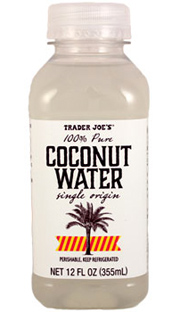
“When you crack this bottle open and take a sip, the first thing you’ll notice is that it is actually pretty similar to Trader Joe’s other coconut water. This certainly puts it leaps and bounds ahead of many of the commercial coconut waters on the market (Zico, VitaCoco, etc, etc, etc) but doesn’t exactly make the case for that bigger price tag. Sure, there are some subtle taste differences that can be dissected – this Single Origin Coconut water seems to go down a little “smoother” and seems to taste a little fresher – but this is largely splitting hairs.
So if they taste the same, why the big price difference. That, of course, is because of the “single origin” quality, featured on the label. As TJ themselves explain on the side, each bottle is derived from a coconuts grown only in Thailand, with 1.5 coconuts going into each bottle. Hence the “single origin” label. While that may be somewhat underwhelming (defining “single origin” as originating within the same general country doesn’t particularly impress me), they also make use of a cold water method of pasteurization called HPP or high-pressure processing, thereby avoiding high temperature pasteurization which degrades the nutritive qualities inherent in the water”